Flashback
The Quest for Identity
I recently wrote about the nostalgia trip that a Crash Test Dummies concert triggered in me, and coincidentally, at around the same time, Steam offered a discount for a game that also brings me back to my childhood.
I can’t quite place the circumstances around which I played the game Flashback: The Quest for Identity (1992) for the first time. Was it the same friend, Meek, who introduced me to it while we listened to Crash Test Dummies on the radio? Or maybe it was my uncle, whose apartment I sometimes stayed over at, and with whom I remember playing other games like Aces Of the Pacific and The Games: Winter Challenge.
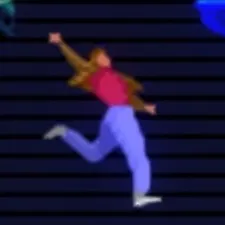
Flashback is a side-scrolling platforming game, similar to Prince of Persia (which is another old favourite of mine), but more advanced in terms of graphics and animation. The protagonist, Conrad, travels through a variety of environments ranging from a jungle to a futuristic city to an alien planet, all rendered colourfully with pixel art. Conrad’s movements are life-like, especially when he jumps or rolls along the ground. As a kid, I was endlessly amused by Conrad’s bad-ass signature move of rolling past an enemy and ending in a crouched stance with pistol drawn and firing.
Even though the memories of my discovery of the game are fuzzy, it was clear from the moment that I booted it up on my Steam Deck that I must have played through it many times. On almost every screen, I knew exactly where I needed to go, and how to solve the puzzles to open the various locked doors, and how to time my movements to defeat each enemy type. It felt as if the game was embedded in my brain, just like a Crash Test Dummies song that I still know the lyrics to after not having heard it in decades.
I have to say, however, that I didn’t really have much fun playing it this time around. I found the controls kind of awkward, especially after the slick and intricate movements of Hornet in Silksong. I think I enjoyed mastering the game when I played it as a kid, but by modern gaming standards, actions like drawing a pistol and shooting it feel so commonplace that I shouldn’t have to struggle through multiple button presses to perform them. I’ve mastered so many more complicated games since then.
Of course, we shouldn’t expect every cultural artifact of our pasts to hold up forever. I can credit Flashback for forming me into the gamer that I am now, even if I won’t be enjoying it ever again.