Hollow Knight
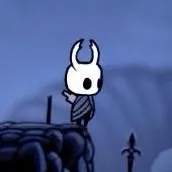
In late August 2025, the release date of Hollow Knight: Silksong, one of the most highly anticipated video game sequels ever, was announced: September 41. Foolishly, I thought to myself, “Hey, maybe I can play the original Hollow Knight in the couple of weeks before Silksong comes out.” I’d always heard good things about it, even though I wasn’t aware of quite how big the fandom is. And, it turns out, how big the game itself is… unless I were to spend almost all of my waking hours playing, there was no way I would have finished it before the sequel’s release.
I had actually tried Hollow Knight briefly when I bought it earlier that summer, but had shifted my attention to another game, because Steam sales inevitably result in a big batch of titles landing in your lap all at once, and you just have to try them all.
The beginning of Hollow Knight can feel a little unwelcoming. You control a little bug, and you start off being only able to jump and hit enemies, which are other little bugs that crawl around in a dark grey world. The 2D levels are mazelike and I didn’t know where I was supposed to be going. Frankly, in the first 30 minutes of the game, I didn’t think there was much to it, and it didn’t seem that fun.
Little did I know how much bigger it would get: the variety of the world’s design keeps growing and growing as you explore, and the gameplay changes whenever your character gains a new ability.
Little did I know that would end up becoming one of my all-time favourite games.
My experience with Hollow Knight encapsulated the two sides of the coin that I brought up in my recent post about gaming. I loved being immersed in Hallownest, the fantasy world where the game takes place, but it sucked me in so much that I kind of lost myself in unhealthy ways.
In my experience, most games have some quirks that constantly remind you that you’re playing a game: all it takes is for some tiny detail to be off—like a sword swing that goes through an enemy instead of hitting it, or your character’s legs continuing to run even though you’ve hit a wall, or even just the font of a menu screen not quite matching the aesthetic vibe of the environment—and it breaks the spell. Hollow Knight nails immersion because it doesn’t have those kinds of flaws.
On the flip side, for me, this meant that “obsession” was not too strong a word. The game is challenging, which means I died a lot, and play sessions inevitably went on longer than I planned because I wanted to take one more crack at a boss or difficult platforming section. Even after I turned it off, the images and movements of the characters would dance through my head. I would mentally practice boss fights that I was stuck on as I fell asleep, sometimes waking up in the morning with a new idea for a combat strategy.
Hollow Knight feels like a game that never ends. Even if you’ve completed the story, and faced all of the enemies that it has to offer, it is infinitely rewarding to master some of the boss fights. I reached a point where I wasn’t able to get past an optional battle, at least not without devoting another dozen hours to practicing it. When I stepped away from the game, I felt like I was transitioning to another phase of life, like changing jobs or moving house. I picked up some other games to try but I was still thinking about Hollow Knight for weeks. Nothing quite absorbed me in the same way.
As of this writing, I have started playing Silksong because it was the only thing that could scratch the itch. I’m trying to approach it with a different mindset, playing it in smaller chunks so that I don’t burn myself out, so I can enjoy it without burying myself in it. Is it working? I’ll get back to you on that.