Love of Perdition
by Camilo Castelo Branco
-
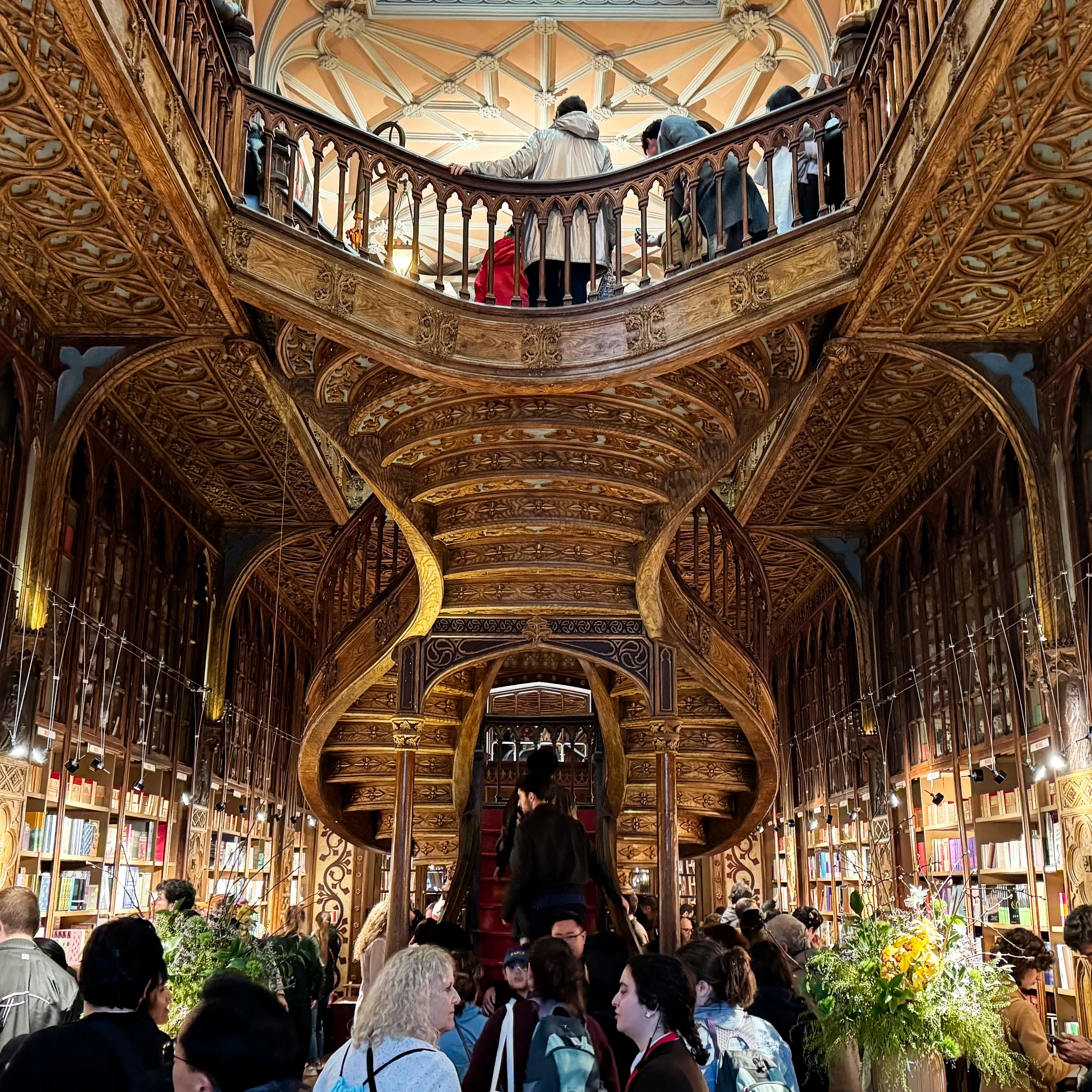
I recently visited Porto, Portugal, and one of the top attractions there is a bookstore called Livraria Lello. It’s got a beautiful interior with a curvy, kind of sexy, central staircase, making it just as picturesque as the numerous churches that you find in Europe. In fact, it’s become so popular that they charge admission to get in, and there’s a queue of eagerly waiting tourists/customers outside the door. Fortunately, the ticket price is applied to any book purchases, so naturally, I bought something.
The store sells a bespoke series of classic public domain works called “The Pop Collection”, and I picked one by a Portuguese author: Love of Perdition by Camilo Castelo Branco. To add even more local flavour, the novel was supposedly written while the author was imprisoned in a jail just around the corner from the bookstore. The book is small and fit nicely inside my satchel, and I carried it with me for the rest of the trip, reading it while sitting in public squares or park benches. It was cool to come across mentions of places—Viseu, Coimbra, and of course, Porto itself—that I had visited days before.
I’m spending a lot of time talking about the context of my reading experience because sadly, I didn’t enjoy the story itself very much. It follows a young couple who fall in love, but are kept apart because their fathers hold a grudge against each other. Their passion is unstoppable, and they refuse to give each other up, resorting to violence and eventually murder.
I struggled to finish this book because I found it hard to connect with the characters. There’s not much emotional depth to them; they’re basically walking adrenal glands whose attraction to each other is based on nothing that’s concretely shown in the book. They barely have any scenes together and most of their relationship is conveyed through fawning letters. To be fair, their obvious analogues, Romeo and Juliet, are equally superficial, but at least they benefit from the power of Shakespeare’s language.
Branco’s writing style, conversely, is rough and inconsistent. There are odd tense shifts in the narration, and frequent author asides where he comments on the art of storytelling. Here’s just one example, where our protagonist is struggling because he’s broke, and Branco proceeds to verbosely explain why being broke is not interesting in a novel.
Simão noticed the tears and thought for a moment about the girl’s dedication; but he did not speak a word to her.
And he returned to thinking about his thorny situation. Disturbing ideas must have crossed his mind that novelists rarely attribute to their heroes. In novels, all crises may be explained except for the ignoble crisis of a lack of money. Novelists consider such a matter as low and plebeian. Style goes grudgingly against shallow things. Balzac talks a lot about money; but money by the millions. I do not know if, in the fifty books I have of his, any gallant in the midst of his tragedy thinks about how to pay his tailor or tries to rid himself of the nets that usurer casts over him from the house of the judge to every corner where he is assailed by capital and eighty percent interest. Masters of novels always manage to escape this. They are well aware that the interest of the reader freezes at the same rate as they see the tavern heroes from whom the affluent reader flees by instinct and the other also runs away as he does not know what else to do. The thing is vilely prosaic, with all of my heart I do confess this.
I understand that this is wholly intentional and that some readers may find the charm in self-aware meta-commentary, but there are so many of these digressions that it took me out of the story.