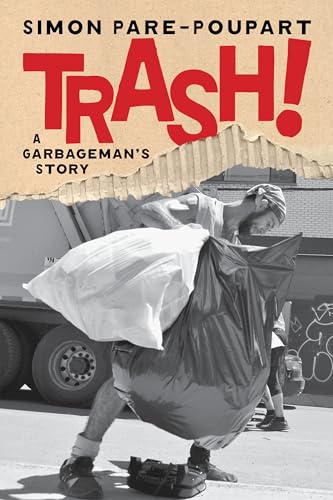
Quotes from Trash! A Garbageman's Story

by Simon Paré-Poupart

Back to book index

Trash! A Garbageman's Story

The garbageman is the Sisyphus of our consumer society, a hapless laborer condemned to go from house to house picking up bags, swept along day after day in the never-ending flow of refuse we produce. And every day he is fated to resume this labor afresh, again and again, for all eternity. If we weren’t there to shoulder this burden, everything would fall apart. The rats would take over, the air would turn fetid, plague and cholera would run rampant. George Bataille was right: excess is the accursed share of abundance, and no one can afford to get stuck with it.

That’s one thing you learn in this business. The garbageman’s yoke is destruction—the opposite of construction, the breaking down of things—and its wages are paid in the sweat on your brow and the pain in your flesh. Garbage juice may be the holy water of your baptism. But it’s the swearing that makes you a real garbageman. That’s when you truly become one with your function. You understand that you’re nothing in the eyes of others, that you’ve got nothing to prove to anyone. You’re at the bottom rung of society’s ladder—but there’s something reassuring in that, because you can’t fall any lower. You’re the living vestige of a bygone era, here in Quebec, at least: the age of the “working man.” But not for you the patina of “working-class heroes” celebrated in popular culture, from Quebec’s novels of rural life’ to Zola’s miners. Nobody writes novels about garbagemen. That doesn’t leave us much to grasp onto, save the freedom that comes with a life on the margins and, in my case, the pleasure of physical labor.


I’ve heard it said that the average garbageman lasts less than ten years behind the truck. Throwing trash takes a real toll. The human body only rarely achieves a level of stamina comparable to the machines we create. “He’s a machine” is a compliment reserved for the very best garbagemen, and rightly so, because these men are as strong as the trucks they ride in. But when we outpace a machine, do we not lose something of our humanity? And isn’t the fact that we’re forced to work at this inhuman pace a sure sign that we’re drowning in waste? Our assembly lines must keep spitting out new things for us to consume at an alarming rate, to keep the factories running and the cargo ships sailing and the airplanes flying and the pistons firing and the servers humming and the screens refreshing and the ads and notifications popping up day and night to goad us into desiring ever more. Our civilization manufactures new things at breakneck speed, only to have them fail ever more quickly. This keeps the wheels of commerce spinning. The end goal of this system is the obsolescence of all goods and all people—an acquiescent, clean, and happy obsolescence.


How is it that this child who looks at me with admiration will grow into an adult who will at best fail to see me and at worst despise me? The answer is, of course, socialization: the transmission of values that slowly but surely draw a line between decency and dirt. When this little boy grows up, he’ll cease to dream of garbagemen. He’ll have understood that we belong in the realm of filth, a place better left unexplored.


I love the chaos of the garbage truck for its own sake. It gives me a space of freedom I can’t find anywhere else. Offer me this deal and I’m all in, without equivocation or qualification. So when corporations and governments come along with plans to regulate and organize this chaos, it does nothing for me. Is it necessary? Maybe. But I’d prefer not to.

It seems eminently reasonable to me to maintain a gray area, one where those who struggle to find their place in society can form a community. Try to conceive of it as a recycling system for “human waste.” Call it social ecology, or reintegration in society. You could think in terms of solidarity among outcasts, a miniature society of people unfit for mainstream consumption, a self-management scheme for deviance, a universal brotherhood of trash. I call it me and my garbageman buddies.


I am convinced that running side by side behind a garbage truck flattens out ethnic differences. We are truly all the same before the load to be lifted, bound tightly together by the task at hand. When you’re throwing trash, only one thing matters: getting that garbage out of the way. And the job requires the close collaboration of newbies and vets, runners and drivers, the fastest and the most agile of us. The work instills a genuine sense of solidarity.

And I’d go a step further. In my view, everyone knows that everyone picking up garbage—Black, Latino, or those labeled as “white trash”—are all basically poor people. Our brotherhood is a gathering of marginal deviants, antisocial conspiracy theorists, eccentrics, and others who have a hard time fully integrating into the “straight world.” This outsider status forges our identity as garbagemen. Sure, we could turn it into a misery contest, argue about who has truly suffered the most and had the hardest time of it, remark how even on the margins we’re not truly equal—but that’s really more of an academic game than what we garbagemen spend our time worrying about.


I’ve always thought that what makes a good helper is the ability to sublimate your impulses and transform them into productive gestures. For many people who have had challenging life experiences, their impulses are negative forces. Becoming a garbageman demands exceptional mastery of physical strength and willpower. It’s not dissimilar to the discipline that top athletes develop over their bodies and minds. But when athletes do it, they have their eyes on a different prize: win medals, break records, entertain the masses with their exploits. And they have the support of a massive system: the media, political forces, and society at large are united in glorifying their performances. Athletes applauded, admired, and earn small or large fortunes.

When I finish a shift, I’ve run fifteen miles. I’ve put my back under duress and taken considerable personal risks to keep your neighborhood clean and healthy. And pretty much no one cares.